As a male in his mature years, (43 at present), the question is often put to me by others near or of similar age "Why do you still read comic books, you realize that the majority of them are marketed for teenagers, right?" Of course this fact is painfully obvious any time that one steps into a comic book store or the graphic novel section of a large book store in the United States, as the bulk of what is represented or collected there is the standard, supremely muscularly, endowed super-heroes or big-eyed manga machinations that are bulging out among various other grotesque adolescent mutations that often are of a similar mold. Within these tropes sometimes this teenage tripe is transcended and taken to another level than the expected type or its known character, (or heroic cast of characters), and is expanded beyond the branded limitations of its paneled borders.
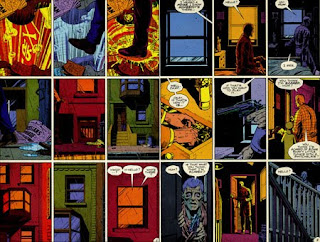
The most well known or popular example of the potential of propelling the super hero past this puerile pummeling or exploring them beneath their sometimes senseless hides is
The Watchmen by Alan Moore and Dave Gibbons, which has had expanded exposure with the release of the recent film. Certainly this collection has earned its notoriety and popularity in its teenage transcendence or trek beyond the typical super-hero, yet there are other preceding and subsequent sequential collections that abound, although they are oft hid among the continual humdrum hoard that is accumulated out of a mostly abhorrently adolescent comic barrage.
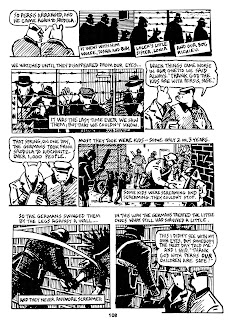
Outside of the massive amount of super-hero subject matter, (or intertwined within it), there are various other themes that have, and continue to inform and interest comic creators including crime, death, history, horror music, religion, sex, (to name but a few broad topics), all of which has been ongoing exponentially, particularly in titles drawn from real-life experiences, or that are autobiographical in nature. One of the most critically recognized of these self-aware titles is
Maus; A Survivor's Tale by Art Spiegelman, which was awarded a Pulitzer Prize Special Award in 1992.
Therefore, one response to the continuation of pursuing comic books into adulthood would be to point out these exemplar explorations, that take a more literate consideration into these heroic graphic accounts, allow for a further or farther contemplation to the mature reader, and as such are worth the condemnation of 'uneducated' adults when they espy you unfolding these colorful or stark comic accounts and begin to snigger or sneer.
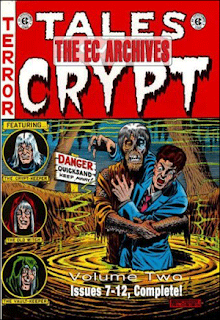
Thus is the intellectual involvement, and certainly it is worth noting or relating in ones defense of an adult comic continuance. Yet for me there is no denying that I have a love for the medium that continues, despite the disappointing deluge of predictable powers that still dominate the comic market in the United States, DC ,(Detective Comics), and Marvel, who continue to cater to the mass method of treating teenagers to predictable and prescribed super-hero procedures. DC, with their Vertigo line, intended for mature adults, has attempted to escape this tender trap, that comic books have wound up being mired or stuck in a prepubescent stage in America since the ‘witch hunts’ of Fredric Wertham in the 1950’s with his outrageous book
Seduction of the Innocent, that nonsensically shut down EC (Entertaining Comics), and struck fear into the heart of every American comic book publisher with childish censoring decency codes.
Comic books in the U.S. survived this downfall, however since then have never completely recovered or shaken the stigma of being comic matter intended for adolescents. Elsewhere in the world, such as in Europe and Asia, the amalgam of image and word not only considers a wider audience, it allows a larger and more refined format to expand its subjects. Still in America, since the seventies there was a serious effort to shake or shuffle out of the strict code restricting comic books, mainly with one of the dominant companies DC, directing to depict real world issues, which were included in the Green Lantern/Green Arrow stories of Dennis O'Neal and Neal Adams. Then there was the underground comics movement with Robert Crumb influencing a multitude of future independent cartoonists, and setting the stage for subsequent self-realized subjects. The American comic boom of the 1980's created many offshoots outside of the big two, DC and Marvel, with serious RAW 'comic' efforts were imported to bring an awareness of the European graphic work to enlighten and entertain the more mature American comic reader. along with neglected sequential art in the states that explored subjects outside of the super-hero idiom.
Therefore despite the dual dominance of conglomerates DC and Marvel there are fortunately other options for the above average aged or non-traditional comic reader, (technically the super-hero genre is referred to as mainstream and other genres or subjects as non-mainstream). Dark Horse is one constant competitor that continues to challenge the expected limits of super-hero subject matter, and one could argue their growing presence was what birthed, (and continues to allow), DC’s Vertigo expansive experimentation. Image Comics occasionally contributes out-of-bounds of the super-hero formula, yet more importantly they allow the creator to own the rights to their work, (this in theory encourages more independence and creativity). ABC, (America’s Best Comics), is an imprint of Wildstorm Productions, that is now owned by DC, however at present remains separate editorially from its ‘parent’ company. Oni-press (which distances itself from super-hero subjects) and Top Shelf Comics are both publishers of alternative sequential stories that include a wide range of subject matter. One of the self-determining comic publishers has even adopted the name Alternative Comics as their named imprint.

Certainly today in America there are more independent comic publishers than in the past, since the collapse of the 1950’s with some die-hards resurrected from an untimely death such as Fantagraphics books, while other underground pioneers such as Kitchen Sink Press have perished (d.1999). Some individuals have even braved the self-publishing avenue and survived, such as Dave Sim (
Cerebus-Aardvark-Vanaheim) and Jeff Smith (
Bone-Cartoon Books). The largest self-publishing American success story was Kevin Eastman’s and Peter Laird’s Mirage Studios which exploded with the creation of their
Teenage Mutant Turtles (today Nickelodeon owns all the rights to this creation, yet supposedly Mirage is allowed to publish 18 issues a year). Webcomics offer a further online alternative, and while I am not at all adverse to these efforts, (I am not a luddite or strict traditionalist), there is an acknowledged personal preference for the printed page, which will be my primary concern.
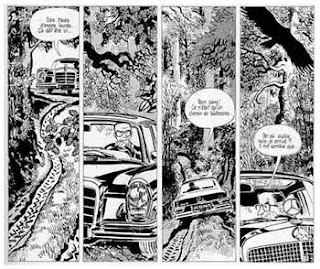
Involved in this ocean of American comics there are options abounding in Europe, (where the medium is more respected). Some of these graphic imports have become available in the states beginning with the early translations in
Heavy Metal, (taken from the French
Métal Hurlant), in 1977 and continuing in Art Spiegelman’s
RAW, (1980-1991). Belgian born Herge’s /Georges Rémi, (1907–1983),
Tintin series, which is of much changed dimensions from its original, yet still marvelous to behold. Jacques Tardi’s work (which has been featured in
RAW), is due to be re-introduced by Fantagraphics with multiple translated stories of his highly influential graphic work. José Antonio Muñoz is an Argentine artist who has heavily influenced a number of American comic creators, (Frank Miller being the most well-known). Hugo Pratt is another comic creator, (from Italy), who has left his mark on Miller, and others in the U.S. Another eminent example of graphic storytelling is the series
Blacksad created by Spanish authors Juan Díaz Canales ( writer) and Juanjo Guarnido (artist). Fortunately for English readers this series has been translated so that the story may be absorbed along with the astounding art.
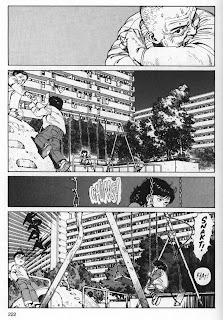
The east has exerted tremendous influence on the American comic field with the import of Katsuhiro Otomo’s
Akira in the U.S. in 1988 by Marvel Comics-Epic Comics, (recently re-published in 2000 by Dark Horse), and writer Kazuo Koike and artist Goseki Kojima’s
Lone Wolf and Cub. These seminal sequential sagas defined manga, (literally whimsical pictures), and the latter in particular has had wide effects upon Western comics from Max Allan Collins’s
Road to Perdition to Frank Miller’s
Sin City. Another early imported Japanese innovator (who remains immensely influential) is Osamu Tezuka’s
Astro Boy.
So the adult comic reader in America has a tidal amount of work to take in, from the past and present, and with this grand overview or cast into this sea my intent is to relate in more detail my past and ongoing experience with comics or the sequential storybook, and how it has influenced my own appreciation and affection for the medium. How in the best examples it transfers an immense possibility that is boundless as it is bounded by certain borders.
Primarily these series of relations will be based upon my understanding of the chronological medium as a reader, as opposed to practical experience as a comic creator. My own illustrative efforts have been more stilled, (and my writing for the most part outside of my drawing); although there is a desire to extend these single acts soon and set down my own sequential efforts, combining the two. While I do not claim to be a pundit in this field, (as compared to say Scott McCloud), there is an accumulated time frame where my perusal of panels have hopefully given me some insight to interest others, or instill in them not only knowledge, yet also the irresistible fondness that is drawn in and around comics, panel by panel.
An ongoing word and picture admirer,
E. Allen Smith
 Recently a close friend gave me a copy of a hardbound volume by editor Derya Ataker in a singular re-collection entitled The Kat Who Walked in Beauty: The Panoramic Dailies of 1920 reprinting some of George Herriman's iconic comic strip formatively featured as a side strip called "The Dingbat Family" which eventually split-off to be run as the noted "Krazy Kat".
Herriman created "The Dingbat Family" in 1910, that was renamed "The Family Upstairs". This serial was to feature a 'sideshow' strip of two animals dubbed "Krazy Kat and Ignatz" that were to become a signature feature, eventually headed as "Krazy Kat", that is widely regarded as one of the best comic strips ever produced by many critics and graphic creators who hold it in utmost respect for its simplicity and shifting surreal aspects.
Recently a close friend gave me a copy of a hardbound volume by editor Derya Ataker in a singular re-collection entitled The Kat Who Walked in Beauty: The Panoramic Dailies of 1920 reprinting some of George Herriman's iconic comic strip formatively featured as a side strip called "The Dingbat Family" which eventually split-off to be run as the noted "Krazy Kat".
Herriman created "The Dingbat Family" in 1910, that was renamed "The Family Upstairs". This serial was to feature a 'sideshow' strip of two animals dubbed "Krazy Kat and Ignatz" that were to become a signature feature, eventually headed as "Krazy Kat", that is widely regarded as one of the best comic strips ever produced by many critics and graphic creators who hold it in utmost respect for its simplicity and shifting surreal aspects.
 There is continual debate of how much underlying social commentary was made in Herriman’s play portrayed of black and white figures, as the creator is cited as being of a Creole upbringing born in New Orleans in 1880. Certainly some societal interplay is intentional on Herriman’s part, particularly on the changing shades within that morph of a rapid exchange. No doubt Herriman intended some communal comment through the anthropomorphic characters wherein the creator deftly cuts up in a further unique blend of language.
The first selected series reprint of “Krazy Kat” strips was offered in 1946 with a noted introduction by e.e. cummings. Thereafter it was forty years until a subsequent re-collection appeared Krazy Kat: The Comic Art of George Herriman edited by Patricia McDonnell, Karen O’Connell, and Georgia Riley de Havenon that remains in circulate reprint.
Of my initial exposure to "Krazy Kat"> was brought about by Art Spigelman and Francoise Mouly through their import in RAW, volume 2, number 3, originally released in 1991.The graphic duo is also cited as leading the re-appreciation of Herriman’s work that as with creator Bud Fisher had diminished almost at that time to the point of obscurity. Of course Herriman’s iconic pair noted as "Ignatz and Krazy Kat" were reborn in Matt Groening’s riff of "Itchy and Scratchy" airing on the animated short in the Bart Simpson Show in 1988, as well as being given wider view in The Simpsons of "There’s No Disgrace Like Home" in 1990. While other cat and mice conflicts influenced "Itchy and Scratchy", such as "Tom and Jerry" and "Herman and Katnip" the basic loop can be reached back to Herriman’s peculiar take that was then projected of myriad cartoon mice, particularly Mickey Mouse.
There is continual debate of how much underlying social commentary was made in Herriman’s play portrayed of black and white figures, as the creator is cited as being of a Creole upbringing born in New Orleans in 1880. Certainly some societal interplay is intentional on Herriman’s part, particularly on the changing shades within that morph of a rapid exchange. No doubt Herriman intended some communal comment through the anthropomorphic characters wherein the creator deftly cuts up in a further unique blend of language.
The first selected series reprint of “Krazy Kat” strips was offered in 1946 with a noted introduction by e.e. cummings. Thereafter it was forty years until a subsequent re-collection appeared Krazy Kat: The Comic Art of George Herriman edited by Patricia McDonnell, Karen O’Connell, and Georgia Riley de Havenon that remains in circulate reprint.
Of my initial exposure to "Krazy Kat"> was brought about by Art Spigelman and Francoise Mouly through their import in RAW, volume 2, number 3, originally released in 1991.The graphic duo is also cited as leading the re-appreciation of Herriman’s work that as with creator Bud Fisher had diminished almost at that time to the point of obscurity. Of course Herriman’s iconic pair noted as "Ignatz and Krazy Kat" were reborn in Matt Groening’s riff of "Itchy and Scratchy" airing on the animated short in the Bart Simpson Show in 1988, as well as being given wider view in The Simpsons of "There’s No Disgrace Like Home" in 1990. While other cat and mice conflicts influenced "Itchy and Scratchy", such as "Tom and Jerry" and "Herman and Katnip" the basic loop can be reached back to Herriman’s peculiar take that was then projected of myriad cartoon mice, particularly Mickey Mouse.
 It is no understatement to relate that Herriman's unique approach had a pervasive effect on subsequent cartoonists, especially the so-called underground 'comix' rebels who drew upon "Ignatz and Krazy Kat" in their turnabout revivals. Of particular mention is Robert Crumb's "Fritz the Cat" which ran from 1965 to 1972, along with Art Spiegelman who began a initial installment of "Maus" within Funny Animals in 1972 that upon comparison with the later renditions in RAW in the 1980's displays how the artist felt that more pared down graphics would convey as much or more through less, as Herriman so deftly handled.
 Spiegelman and Mouly-who not incidentally gave print awareness to graphic creator Chris Ware, that later made his own revision of Herriman's rodent titled "Quimby the Mouse" as well as designing the covers for the future Fanatagraphic reprints (of which detail to follow)- were well aware of the importance of Herriman’s singular strip, and of its slighted recognition, were the "Krazy Kat" reprint in RAW re-presented as "Tiger Tea" conveying 48 consecutive strips that are imparted of an introduction by Bob Callahan as the cohesive narrative that Herriman created. The import of RAW within North America is worth much additional praise, for it is by Spigelman’s and Mouly’s editorial efforts and enthusiasm that returned Herriman’s due strip to new readers, who might have otherwise overlooked the singular creator’s contribution.
Spiegleman was further recognizing Herriman’s subtle, yet stark dig, and overturn of the ‘cat and mouse game’, with Spiegleman noted as remarking of the racial undertones struck influencing his own anthropomorphic exploration attempting to relate his father’s experience in being imprisoned in a Nazi concentration camp in World War II imparted as "Maus". Spiegelman’s comments upon the racial representation, stereotyping African Americans can be reviewed at http://www.nytimes.com/1985/05/26/books/cats-mice-and-history-the-avant-carde-of-the-comic-strip.html.
Spiegelman and Mouly-who not incidentally gave print awareness to graphic creator Chris Ware, that later made his own revision of Herriman's rodent titled "Quimby the Mouse" as well as designing the covers for the future Fanatagraphic reprints (of which detail to follow)- were well aware of the importance of Herriman’s singular strip, and of its slighted recognition, were the "Krazy Kat" reprint in RAW re-presented as "Tiger Tea" conveying 48 consecutive strips that are imparted of an introduction by Bob Callahan as the cohesive narrative that Herriman created. The import of RAW within North America is worth much additional praise, for it is by Spigelman’s and Mouly’s editorial efforts and enthusiasm that returned Herriman’s due strip to new readers, who might have otherwise overlooked the singular creator’s contribution.
Spiegleman was further recognizing Herriman’s subtle, yet stark dig, and overturn of the ‘cat and mouse game’, with Spiegleman noted as remarking of the racial undertones struck influencing his own anthropomorphic exploration attempting to relate his father’s experience in being imprisoned in a Nazi concentration camp in World War II imparted as "Maus". Spiegelman’s comments upon the racial representation, stereotyping African Americans can be reviewed at http://www.nytimes.com/1985/05/26/books/cats-mice-and-history-the-avant-carde-of-the-comic-strip.html.
 Following RAW, Kitchen Sink Press undertook to reprint The Komplete Kolor Krazy Kat, edited by Rick Marshall, and composed of a consortium of comic publishers representing Eclipse Comics and Turtle Island Press, along with the aid of Bill Blackbeard, that was unfortunately cut short with the demise of Eclipse in 1992.
Bill Blackbeard resumed to include all of Herriman’s "Krazy Kat" Sunday strips in 2002 with the backing of Fantagraphics Books who have recently completed this daunting task of 13 volumes re-presenting the serial from April 23, 1916 unto June 25th, 1944 when Herriman died.
Following RAW, Kitchen Sink Press undertook to reprint The Komplete Kolor Krazy Kat, edited by Rick Marshall, and composed of a consortium of comic publishers representing Eclipse Comics and Turtle Island Press, along with the aid of Bill Blackbeard, that was unfortunately cut short with the demise of Eclipse in 1992.
Bill Blackbeard resumed to include all of Herriman’s "Krazy Kat" Sunday strips in 2002 with the backing of Fantagraphics Books who have recently completed this daunting task of 13 volumes re-presenting the serial from April 23, 1916 unto June 25th, 1944 when Herriman died.
 Someday it is hoped that my own select collections may be added to of this complete edition, although as editor Derya Ataker who was involved in the larger project with Fantagraphic Books reveals in the stand –alone collection The Kat Who Walked in Beauty: The Panoramic Dailies of 1920 there is almost a infinite appreciation to be found in Herriman’s supplements that offer a near inestimable amount of enjoyment and absorbing study.


